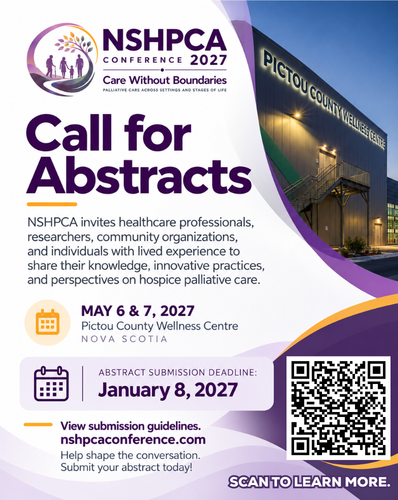
Care Without Boundaries: Palliative Care Across Settings and Stages of Life
Have research, innovative practices, or lived experiences that could help shape the future of hospice palliative care? We want to hear from you!
The Nova Scotia Hospice Palliative Care Association invites healthcare professionals, researchers, community organizations, and individuals with lived experience to submit abstracts for our 2027 Provincial Conference.
The Nova Scotia Hospice Palliative Care Association provides leadership in hospice, palliative care, grief, and emotional wellness across Nova Scotia. While we do not operate or provide hospice beds, we support communities through education, programs, advocacy, and system-level collaboration that strengthen care across the province.
Our work focuses on advancing equitable, compassionate palliative care and grief support by connecting communities, elevating lived experience, building shared knowledge, and helping shape policy and practice to improve outcomes for individuals and families.
How we can help
Hospice Palliative Care
What is hospice palliative care? We can help you navigate the process.
Hospice is a philosophy of care that focuses on comfort, dignity, and quality of life for people living with life-limiting illness. Care supports the whole person – physical, emotional, social, and spiritual.
Who is hospice care for?
Hospice care is for individuals with serious illness and for the people who care about them. It supports both the person receiving care and their family or caregivers.
Where is hospice care provided?
Hospice care can be provided in many settings, including at home, in hospice facilities, long-term care, or hospitals, depending on individual needs and community resources.
There are three hospice residences in Nova Scotia:
For more information on where to access hospice services, please visit our Local Supports page.
Does hospice mean giving up?
No. Hospice care focuses on comfort and quality of life. It supports people in living as fully and comfortably as possible.
Is hospice only for the final days of life?
Hospice care can be helpful at different stages of serious illness and is most effective when introduced early, alongside other supports.
What is a hospice residence?
Hospice care is a part of palliative care. A hospice residence provides a home-like setting for people who are nearing the end of life, who don’t require care in the hospital, yet have more care needs than can be provided at home, to live to their fullest. Hospice care involves a wide range of services to support patients and their families to live as fully and comfortably as possible. Patients receive professional nursing care with physician support 24 hours a day, seven days a week. This includes medical and personal care to manage symptoms and improve quality of life. Other health care providers, such as social workers, music therapists, and trained volunteers provide emotional, spiritual, grief and bereavement support.
Hospice residences are available to all Nova Scotian’s with a valid health card. Additional costs may apply. Please ask your local hospice what this may mean for you. For example, at Halifax Hospice (operated by the Halifax Hospice Society) medications are supplied by a community pharmacy, so if there is a copay for your medication when you are at home, that may be the same when you are in Hospice. At Valley Hospice and Hospice Cape Breton (operated by Nova Scotia Health) medications are supplied the same as if you were in hospital. If a person requires an ambulance transfer from home to hospice, there may be costs with this. Speak with your hospice team to learn more and if you have any concerns about costs.
How do I access a hospice residence in Nova Scotia?
Each hospice residence has their own referral and admission process. You can find details here.
Wall of Memory
Where photos and stories provide a way to share, preserve and celebrate a loved one’s legacy.
If you have any questions about funding and funding applications please contact funding@nshpca.ca.
Meet With Us
Chanda MacDonald
Chanda MacDonald has been a Registered Nurse with Nova Scotia Health for 26 years, bringing a strong foundation in clinical practice and 13 years of dedicated service currently as a Clinical Nurse Educator in the Northern Zone. A passionate mentor to new nurses and a national leader in clinical best practices, Chanda has dedicated her career to empowering interprofessional teams to deliver compassionate, evidence-based care.
In 2026, Chanda’s professional expertise and personal life intersected in the most profound way following the passing of her 20-year-old daughter, Raleigh. Navigating this devastating loss as both a mother and a seasoned healthcare professional has reshaped her perspective on communication, advocacy, and presence at the bedside.
At this year’s conference, Chanda shares an honest, deeply moving reflection on walking alongside her daughter, bridging clinical excellence with the human empathy that defines palliative and end-of-life care. She will share on what it means to navigate grief, advocacy, and relational care from both sides of the hospital bed.
Yvonne Heath
After a 27-year nursing career, Yvonne Heath discovered her new calling: helping people find the courage to Just Show Up when life gets hard.
She is the founder of Compassionate Solutions, an award-winning author, speaker and trainer, creating social change by transforming the way we navigate grief, addiction, transitions, and end of life.
With her background in healthcare and family’s lived experience supporting a son through addiction, Yvonne combines professional expertise with deeply personal insight.
She is passionate about Supporting the Supporters and Helpers—the families, friends, professionals, volunteers, leaders, and communities who care for, and about others. And teaching that caring for themselves is non-negotiable.
Her mission: Creating Compassionate Communities where anyone can Recover out Loud, from whatever they are facing. And everyone will Just Show Up with Heart, Humour and Humanness—No. Matter. What.
When they aren’t traveling, Yvonne and her husband, Geordie can be found wearing socks and sandals in their happy place in Huntsville, Ontario, with their cats, Calvin and Hobbes.
Betty Jean Aucoin
Betty Jean Aucoin is a retired educator, former principal, professional learning leader and adjunct professor with more than three decades of experience connecting with audiences and facilitating meaningful learning.
Living with stage IV metastatic breast cancer, Betty Jean brings both professional insight and personal experience to conversations about uncertainty, self-care, self-advocacy, resilience and the everyday choices that support quality of life.
As a yoga and mindfulness instructor, wellness consultant and author of RISE: Living Life Over Cancer, she advocates integrative care: evidence-based medical treatment complemented by supportive approaches to mind, body, heart and spirit. Her message honours difficult realities while making room for joy and purpose.
Dr. Holly Prince
Dr. Holly Prince is an Anishinaabekwe and a member of Opwaaganisiniing in Northwestern Ontario. She has a Ph.D. in Educational Studies and a Master’s of Social Work. Dr. Prince’s research focuses on decolonial and Indigenist education, the resurgence and re-activation of Indigenous Knowledges, Indigenous health equity and community-based research.
Dr. Prince leads the Indigenous People’s Health & Aging Division at the Centre for Education and Research on Aging & Health, Lakehead University. She is also the Senior Advisor and Project Lead to the Canadian Virtual Hospice’s Indigenous Voices initiatives. In addition to her leadership roles, Dr. Prince is a Coach and Advisor for Healthcare Excellence Canada’s Improving Equity in Access to Palliative Care initiative, which aims to support people experiencing homelessness or those who are vulnerably housed.
Dr. Prince has devoted the last 20 years to advancing Indigenous Peoples’ right to access culturally appropriate and equitable healthcare and has mobilized her efforts as a national champion of human rights and dignity for people preparing to journey back to the spirit world.